[:ru]Прейльский музей истории и прикладного искусства (Латвия), Гродненский государственный музей истории религии (Беларусь) и Паневежский краеведческий музей (Литва) в рамках проекта «Продвижение исторического и культурного наследия на пограничье посредством внедрения инноваций в музеях» (ENI-LLB-1-244) программы трансграничного сотрудничества Латвия-Литва-Беларусь 2014-2020 представляют совместную виртуальную выставку «Обувь». [:en]Preili Museum of History and Applied Arts (Latvia), Grodno State Museum of the History of Religion (Belarus) and Panevezys Local Lore Museum (Lithuania) joint virtual exhibition – footwear.[:]

[:ru]Прейльский историко-прикладной музей

Есть ли на земле уголок, куда никогда бы не ступила нога человека? За тысячу лет были покорены как самые высокие вершины, так и самые глубокие каньоны и низины. Сможет ли человечество обойтись без правильной обуви — от самых обычных кожаных мокасин и постолов до культовых «Air Jordan». Куда бы вы ни пошли, у вас всегда будет обувь — со своим отпечатком и своей историей.

Коллекция обуви в коллекции Прейльского историко-прикладного музея относительно невелика, но она формирует полную картину того, что обувь была действительно важным атрибутом для жителей Прейли, используемым в ХХ веке.
[:en]Preili Museum of History and Applied Arts

Is there a corner on the earth where a human foot would never have stepped? In a thousand years, both the highest peaks and the deepest canyons and lowlands have been conquered. Would humanity be able to do it without the right shoes — from the most ordinary leather moccasins and postols to the iconic «Air Jordan». Wherever you go, you will always have shoes on your feet — with your imprint and your story.

The collection of footwear in the collection of the Museum of History and Applied Art of Preili is relatively small, but it forms a comprehensive picture of what footwear did Preili inhabitants used during the 20th century walking city streets and dusty country roads.[:]

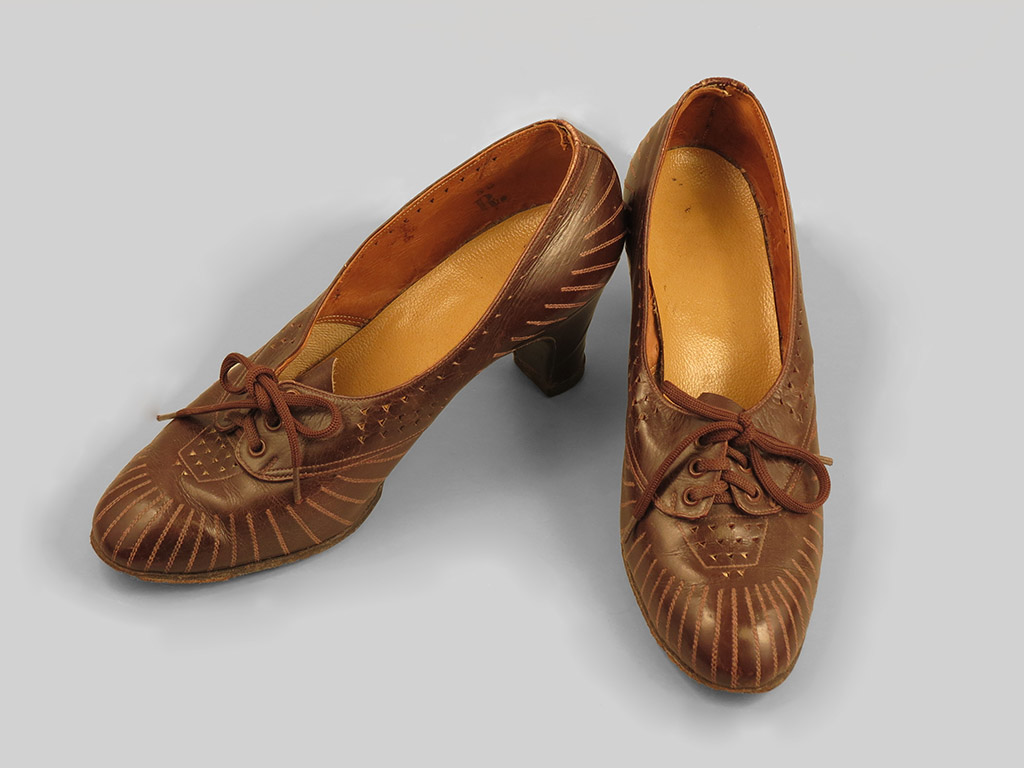
[:ru]Кожаная обувь. 1930-е годы

Кожаная обувь Еликамиды Ивановой — одна из лучших в коллекции музея. Туфли имеют высокий каблук и декоративную шнуровку по верху. Каждая деталь показывает мастерство рук работников обувной фабрики Д. Могильникова, работающую в Риге, которая продвигает высокие стандарты качества основателя фабрики – Давида Могильникова, который получил золотую медаль за качество его продукции на вставке в Париже в 1927 году.

Е. Иванова жила в Прейли, всю жизнь проработала на Прейльской почте, но в свободное время активно участвовала в общественной жизни города. Не ясно, как Е. Иванова получила эти туфли, может быть, ее брат — известный композитор Янис Иванов – подарил ей их. Однако в конце 1940-х годов Дж. Иванова отдала свои туфли своей соседке по комнате Матрене Котеровой, которая не могла продолжать носить туфли, потому что они были слишком маленькими, но высоко оценила качество подарка, храня его.
[:en]Leather shoes. 1930’s

Leather shoes owned by Jelikamida Ivanova are one of the finest shoes in the museum’s collection. The shoe has a high heel and decorative lacing on the upper. Every detail shows the fine handiwork of the employees of «D. Mogilnikov shoe factory» working in Riga, which was undoubtedly promoted by the high-quality standard of the owner of the factory — David Mogilnikov, who won a golden medal for the quality of his products in Paris in 1927.

J.Ivanova lived in Preiļi, working all her life at Preiļi post office, but in her free time she actively participated in the public life of the city. It is not clear how J.Ivanova got these shoes, maybe her brother – the famous composer Jānis Ivanovs — gave them as a present to her. However, at the end of the 1940s, J.Ivanova gave her shoes to her roommate Matrjona Kotļerova, who could not continue to wear the shoes, because they were too small, but highly appreciated the quality of the gift keeping them.[:]

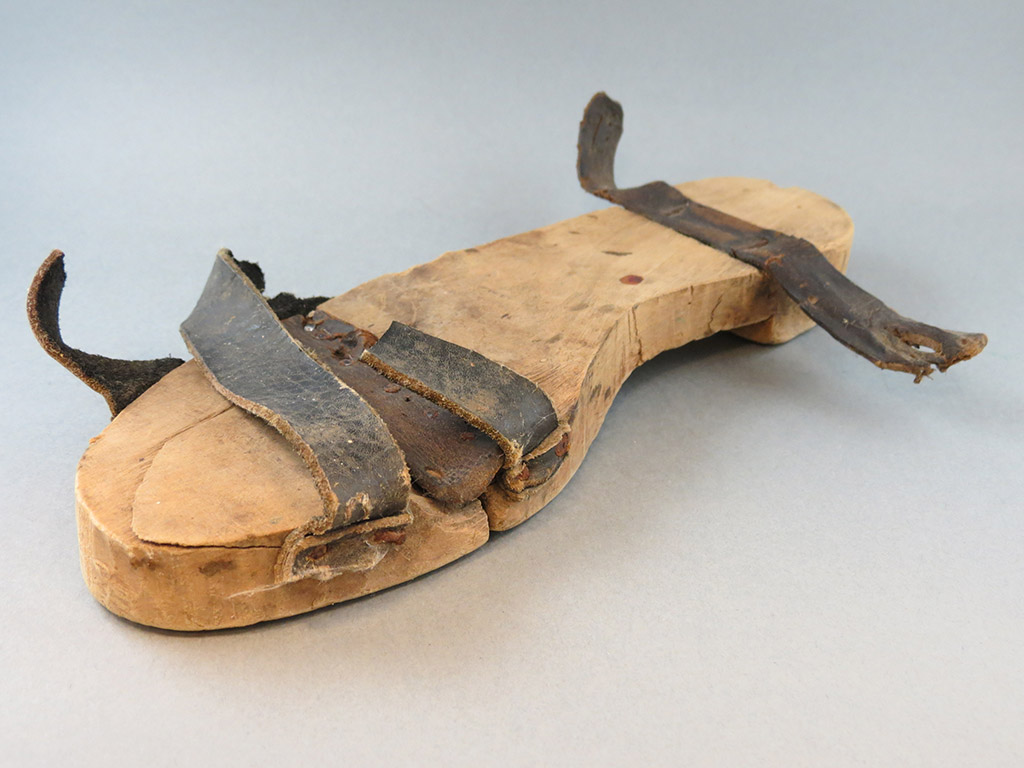
[:ru]Паттены. 1940-е годы

Паттены, или туфли на деревянной подошве, назывались klikatiņas (вероятно, из-за их специфического звука при ходьбе). Созданы во время Второй мировой войны, принадлежал Валентине Дзене, которая живёт в деревне Дзени, Прейльского района.

Из-за недостатка в обуви, klikatiņas стали широко использоваться женщинами во время войны, также их называли «Бережливая обувь». Такая обувь была широко популяризирована в прессе во время немецкой оккупации. Например, 15 марта 1942 года газета «Darbs un Zeme» опубликовала объяснение, почему женщины должны носить такую ​​обувь, а также образцы узорчатой обуви, используемой в Германии, с чертежами и инструкциями по изготовлению. Паттены состояли из деревянных подошв и кожаных ремней. Для повышения гибкости подошвы ее распиливали на две части, соединия затем их полоской кожи. Вместо кожи можно было использовать ткань или подвязки.
[:en]Wooden patten. 1940’s

Pattens, or shoes with a wooden sole, were called klikatiņas (probably due to their specific sound while walking). Made during World War II, belonged to Valentīna Dzene, who lived in Dzeni, Preili Parish.

Due to the shortage of footwear, klikatiņas became widely used by women during the wartime, also called » frugality shoes». Such shoes were widely popularized in the press during the German occupation. For example, on March 15, 1942, the newspaper “Darbs un Zeme” published an explanation why women have to wear such shoes, as well as samples of the patten shoes used in Germany with drawings and manufacturing instructions. The pattens were made of wooden soles and leather ties. To make the sole bend, it was sawed in two parts, joining the parts together with a strip of leather. Fabric or garters could also be used instead of leather.[:]

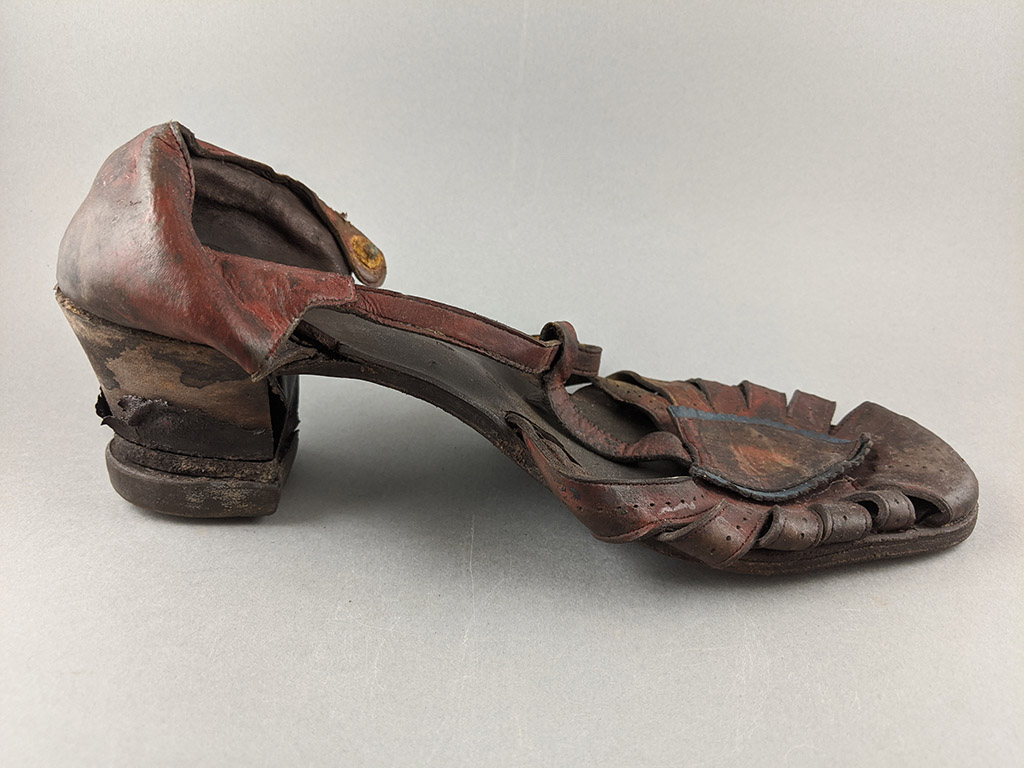
[:ru]Кожаная обувь. 1930-е — начало 1940-х гг.

В 2016–2018 годах было проведено несколько раскопок около еврейского кладбища Прейли, где летом 1941 года убили евреев Прейли и его окрестностей. Целью раскопок было определение границ места захоронения для последующего благоустройства территории и создания мемориала. В ходе работ была определена граница одной братской могилы, а также получены очень ценные предметы – обувь жителей Прейли, погибших во время Холокоста.

Летом 1944 года немецкие войска отступали по всей территории Латвии, пытаясь скрыть свои преступления, они сжигали тела убитых. То же самое произошло в Прейли. 20 найденных ботинок лежали на краю братской могилы, нетронутой огнем.

Эти красные женские сандалии с высоким каблуком и декоративным «листом» на пальце ноги, является не только свидетельством того, какую обувь использовали в Прейли в начале 1940-х годов до немецкой оккупации, но и уникальное свидетельство о Холокосте в Прейли и по всей Латвии.

[:en]Leather shoe. 1930’s – the beginning of 1940’s

On November 2-16, 2018, several control excavations were carried out near the Preiļi Jewish Citizens’ Cemetery at the site where in the summer of 1941 Jews of Preiļi and the surrounding area were killed. The purpose of the control excavations was to find out the boundaries of the shooting site for the later improvement of the territory and the creation of a memorial. During the works, the boundaries of one mass grave was located and also very valuable items were obtained — the shoes of the Preili inhabitants killed during the Holocaust.

In the summer of 1944, German troops retreated throughout the territory of Latvia, trying to hide their crimes by burning the bodies of those killed. The same happened in Preili. The 20 shoes found were on the edge of a mass grave untouched by fire.

This red women’s sandal, with a high heel and a decorative «leaf» on the toe, is not only a testament to what shoes were used in Preili in the early 1940s before the German occupation, but also a unique testimony of the Holocaust in Preili and all over In Latvia.[:]

[:ru]Гродненский государственный музей истории религии

Обувь является важной частью костюма и защищает ступни от воздействия холода, грязи, влаги и механических повреждений острыми камнями, шипами, корнями деревьев, выступающими над поверхностью почвы.

Наиболее древним видом обуви на территории Беларуси являются плетеные из лыка или коры лапти, с давних времен известные как славянам, так и балтам. Как минимум с конца XVI века лаптями могли называть и кожаную обувь, более известную как постóлы, или поршни. Кроме лаптей из лыка или коры и постолов к  традиционной на территории Гродненской области также относится обувь из кожи или полотна на деревянной основе, сукна, льняных веревок, ниток. Интересно, что лапти из лыка или коры, даже выйдя из обихода, могли сохранять обрядовое значение. В некоторых деревнях считалось, например, что если умершего похоронить в кожаной обуви, то животное, из кожи которого она сделана, на том свете потревожит усопшего, требуя обратно свою кожу. Во время свадьбы жениху и невесте дарили лапти как символ верности, чтобы молодожены всегда были в паре.

В отличие от сельского населения, жители городов носили практически исключительно кожаную обувь. Постолы, которые широко используются в IX-XIII веках, постепенно дополняются сапогами, полусапогами и туфлями на невысоком кожаном каблуке. Это неудивительно, ведь, например, Гродно был известным центром выделки кож, что отражено даже на знаменитой гравюре Цюндта (Matthias Zündt, 1568). Найденная археологами в Гродно средневековая обувь отличается лаконичностью форм и практически полным отсутствием декора в сравнении с обувью из Минска, Бреста или Полоцка.

[:en]Hrodna State Museum of the History of Religion

Shoes are an important part of the dress. They protect the feet from cold, dirt, moisture and mechanical injury by sharp stones, thorns, and tree roots protruding above the soil surface.

The most ancient type of footwear on the territory of Belarus is bast shoes, woven from bass or bark. They were known to both the Slavs and the Balts for a long time. At least from the end of the 16th century, leather shoes, better known as postols or porshens (a kind of sandals strapped to the feet), could also be called bast shoes. In addition to bast shoes made of bass or bark and postols, footwear made of leather or linen with a wooden bottom, cloth, linen ropes and threads was also traditional in the Grodno region. It is interesting that bast shoes made of bass or bark, even when they were out of use could retain their ritual significance. In some villages, for example, it was believed that if the deceased was buried in leather shoes, then the animal from whose skin it was made would disturb the deceased in the next world demanding its skin back. During the wedding, the bride and groom were presented with sandals as a symbol of loyalty, so that the newlyweds were always a couple.

Unlike the rural population, town dwellers generally wore nothing more than leather shoes. Postols, which were widely used in the 9th-13th centuries, were gradually complemented by boots, half boots and shoes with low leather heels. This is not surprising, because, Grodno, for example, was a well-known center of currying, which is reflected even in the famous engraving of Zündt (Matthias Zündt, 1568). The medieval footwear found by archaeologists in Grodno is distinct in its laconic form and almost complete lack of decor in comparison with footwear from Minsk, Brest or Polotsk.[:]

[:ru]Постóлы (поршни). Беларусь. Начало ХХ в. Кожа, шитье.

Постóлы, которые использовались в Гродненском регионе еще в начале ХХ века, отличаются от современной обуви отсутствием твердых деталей (подошвы, спинки, пятки). Изначально они изготавливались, как правило, без использования специальных инструментов или обувных колодок из одного куска кожи, края которого загибались. Для закрепления постол на ноге в заготовке делались сквозные прорези, через которые протягивались ременные оборки. Более сложным вариантом были постолы из двух кусков кожи, внешний из которых на носках прорезался. В прорези вплетали кожаные ремешки или шнурки, создавая таким образом ажурный узор.
[:en]Postols (porshens). Belarus. The beginning of the 20th century. Leather, stitchwork

Postols, which were used in the Grodno region at the beginning of the twentieth century, differ from modern footwear as they do not have solid details (a shoe sole, a shoe back, and a heel). Initially, they were made, as a rule, without the use of special tools or shoe lasts from one piece of leather, the edges of which were bent. To fix the postol on the foot, through slots were made in the shoemaking upper, through which belt frills were pulled. More sophisticated postols were made of two pieces of leather, the outer one of which was cut through on the toe-cap. Leather straps or laces were woven into the slots, creating a lace pattern.[:]

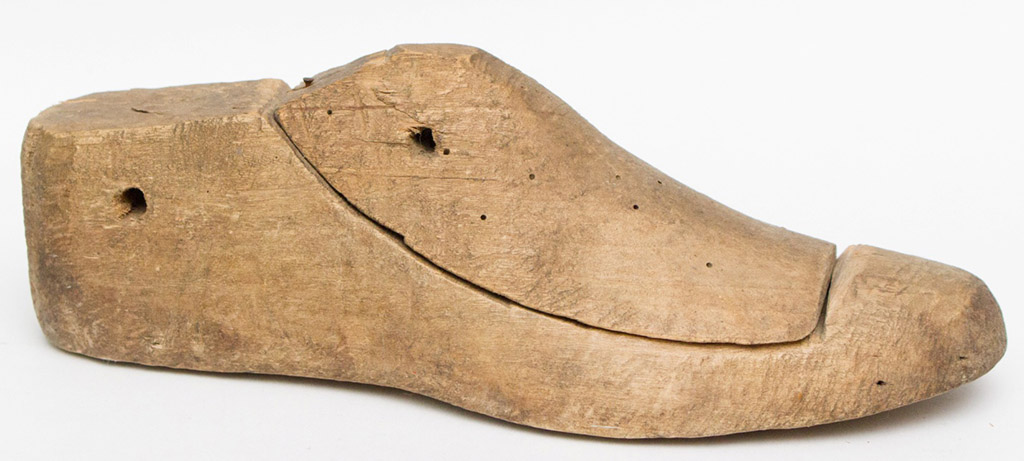
[:ru]Колодка обувная. Мастер Миканович Иван Петрович. д. Минютевка Шчучинского района. 1925-1927 гг.

Обувная колодка (бел. «капыл») — это кусок дерева в форме ступни, на котором сапожник традиционно изготавливает обувь.

Хотя обувные колодки находили во время археологических раскопок древних Полоцка, Минска, Бреста в слоях XI – XIII веков, они долгое время оставались атрибутом городских ремесленников и почти не использовались в деревнях. Однако постепенно профессиональный уровень сельских мастеров рос, и они начинали использовать все более совершенные средства. Поэтому даже в производстве примитивной обуви из лыка или пеньковых веревок к началу ХХ века повсеместно использовали колодки, как правило, из березы или ольхи с набитыми на них гвоздями.

Изначально колодки целиком изготавливались вручную специально для каждой пары обуви. Колодки разных мастеров отличались друг от друга, поэтому в белорусском языке сохранился фразеологизм «рабіць на свой капыл», означающий «делать что-то по-своему».
[:en]Shoe last. Craftsman Mikanovich Ivan Petrovich. Village Minyutevka of Schuchyn region. 1925-1927

Shoe last (Belarusian equivalent «kapyl») is a piece of wood in the shape of foot. Traditionally, the shoemaker uses it to make the shoes.

Although shoe lasts were found during archaeological excavations of ancient Polotsk, Minsk, Brest in the layers of the 11th — 13th centuries, they remained an attribute of urban artisans for a long time and were almost never used in villages. However, gradually the professional level of rural craftsmen grew, and they began to use more and more sophisticated materials and tools. Therefore, by the beginning of the 20th century even in the production of primitive shoes from bast or hemp ropes, shoe lasts were widely used. As a rule, they were made from birch or alder with nails battered in them.

Initially, the shoe lasts were entirely hand made specifically for each pair of shoes. Shoe lasts of different shoemakers differed from each other. This is why, the phraseological unit “to make something using your own kapyl”, meaning “to do something in your own way”, has been preserved in the Belarusian language till now.[:]

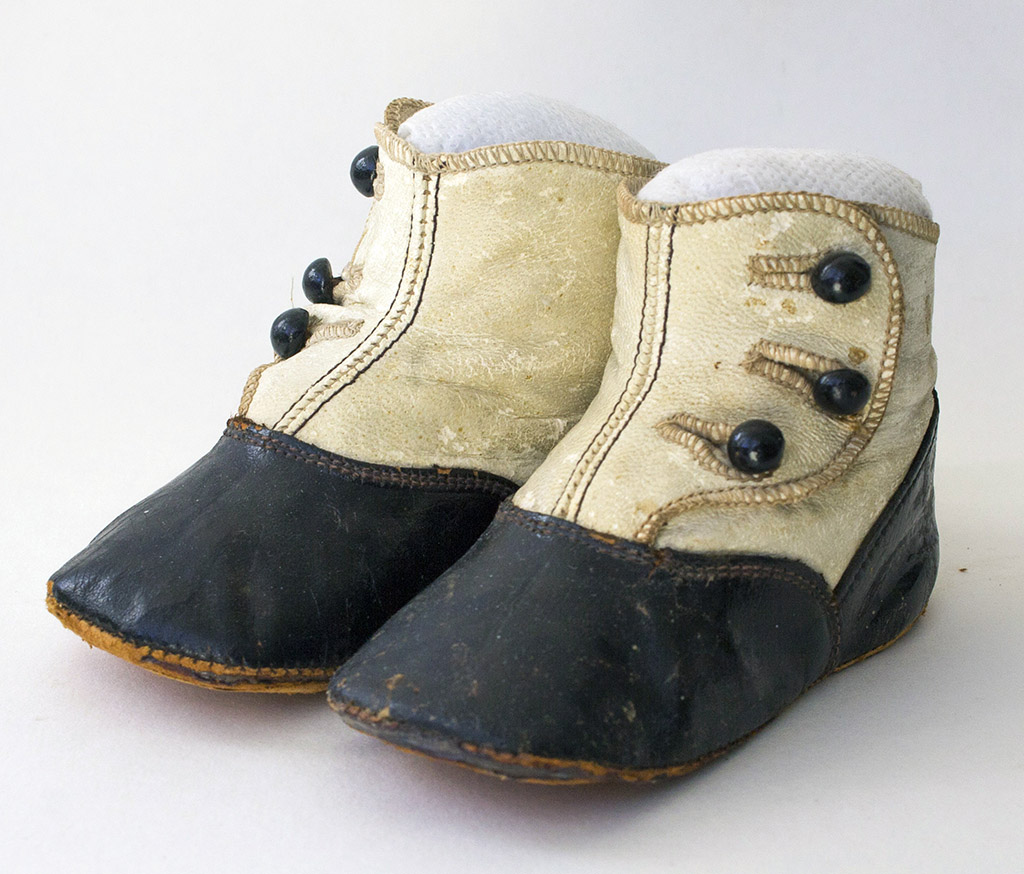
[:ru]Детская обувь («пинетки»). Франция. Конец XIX века. Кожа, кость, шитье

До середины XIX века об обуви для самых маленьких практически не задумывались. Младенцы туго пеленались, и в изготовлении особой обуви для них не видели необходимости. Миниатюрные ботиночки стали распространяться после 1860 г., когда французский мастер Франсуа Пине (François Pinet) начал производство детской обуви. Пине к тому времени уже был известен в Париже как модный производитель женских туфель, его популярность быстро росла, к тому же он стал одним из первых, кто ставил авторские клейма на свои изделия. Обувь Пине, которого вместе с Чарльзом Уортом считают одним из создателей феномена haute couture, относилась к элитной, но находила ценителей и за границей, в том числе в Российской империи. Туда активно поставляли и детскую обувь Пине, поэтому скоро и изделия других мастеров, подобные ей, стали называть пинетками.

Первые детские ботиночки Пине представляли собой мягкую обувь без жесткой подошвы, которая крепилась на ноге с помощью пуговицы. Представленная пара является несколько более поздней закрытой вариацией на трех пуговицах, предназначенной для носки в прохладную погоду. 

[:en]Children’s shoes (“pinetki” or baby-shoes). France. The end of the 19th century. Leather, bone, stichwork

Until the middle of the 19th century, shoes for babies were not practically thought of. Babies were swaddled tightly, and there was no need to make special shoes for them. Miniature shoes began to spread after 1860, when French craftsman François Pinet began making children’s shoes. By that time, Pinet was already known in Paris as a fashionable manufacturer of women’s shoes. His popularity was growing rapidly; moreover, he became one of the first to put designer brands on his products. Pinet, as well as Charles Worth, is considered to be the creator of the haute couture phenomenon. His shoes belonged to the elite ones, but found their connoisseurs abroad, including in the Russian Empire. Pinet’s children’s shoes were also actively supplied there. So, soon the products of other masters, similar to his shoes, began to be called “pinetki”.

The first Pinet’s children’s shoes were soft shoes without a rigid sole, which were fixed to the foot with a button. The presented pair is a more late closed variation with three buttons designed to be worn in cool weather.[:]

[:ru]Паневежский краеведческий музей

Основное предназначение обуви — защитить ноги от внешних воздействий. В то же время это музейные реликвии разных периодов, отражающие моду эпох, культурные традиции и экономическое положение. Обувь может описывать состояние человека, место проживания, социальный класс или даже род занятий. Пословицы и поговорки, встречающиеся в литовском фольклоре, свидетельствуют о том, что сам человек мог быть описан по его обуви.

Примеры обуви из разных эпох, хранятся в фондах Паневежского краеведческого музея: женская, мужская, детская обувь, ручная работа и фабричная обувь. Старейшие из них произведены в конце ХІХ века. Исключительными примерами является обувь из Паневежиского театра драмы.
[:en]Panevėžys Local Lore Museum

The primary purpose of footwear is to protect feet from external influences. At the same time, they are museum relics of various periods, reflecting the fashions of the epochs, cultural traditions and economic situation. Footwear can describe a person’s wealth, place of residence, social class or even occupation. Proverbs and sayings found in Lithuanian folklore testify that the person himself was described according to his shoes.

Examples of footwear from different periods are stored in the funds of Panevėžys Local Lore Museum: women’s, men’s, children’s shoes, handmade, shoemaker-made and factory-made footwear.  There are lots of collected footwear worn by peasants: bast-shoes, carbatinae, klomps, clogs, knitted slippers. The oldest of them are of the end of 19th century. Exclusive examples of footwear are shoes of Panevėžys Drama Theater performance characters.[:]

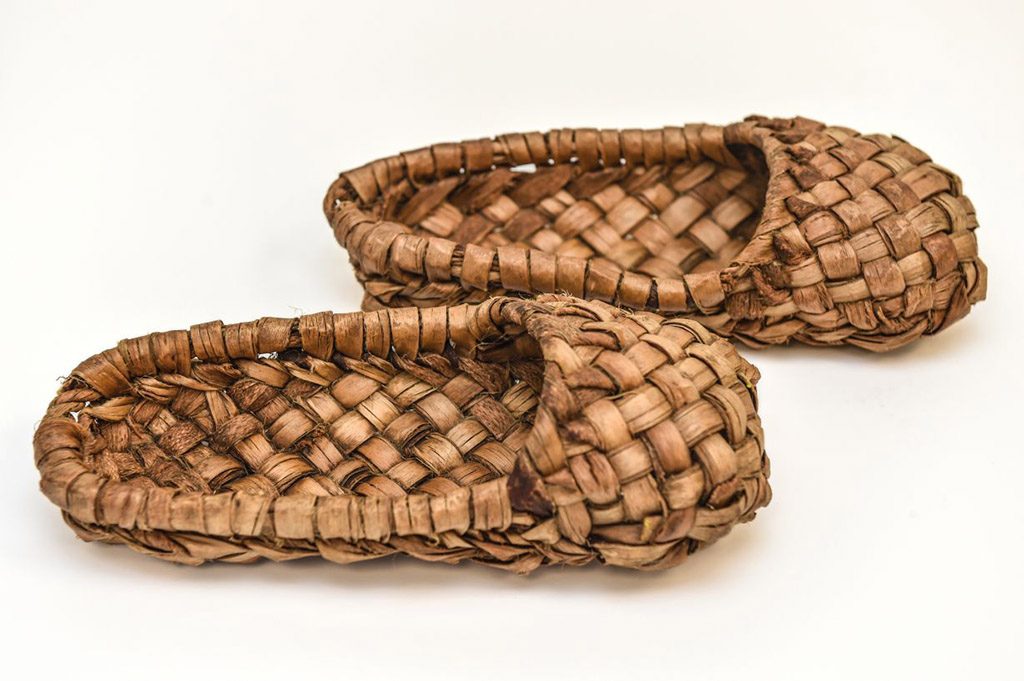
[:ru]Женские лапти . 1930–1940- е гг. Фотография Г. Картанаса .

Лапти — это традиционная обувь ручной работы, сделанная из полос коры деревьев (обычно липы, ивы или ивы) изнутри, называемой лубом. Эти лапти скручиваются по диагонали из двух полос длиной 2 метра и шириной 2 сантиметра. По бокам для лапника устанавливаются петли (не сохранились). Перед тем, как надеть лапти, мужчины обматывали ноги портянками, женщины надевали носки. Подошвы были оплетены толще, иногда подшивались кожей. Лапти носили круглый год. Зимние лапти были длиннее и шире, изнутри утеплялись грубой тканью или кожей. Дольше всего их носили в регионах Аукштайтии и Дзукии — даже до середины ХХ века.
[:en]Women’s bast-shoes. 3rd-4th decades of the 20th century. Photo of G. Kartanas.

Bast-shoes are a traditional handmade shoes made from the inside of trees (usually linden, osier or willow) bark strips, called bast. These bast-shoes are braided diagonally two-heddled of 2 m length and 2 cm wide linden bast. Loops are installed on the sides for bast-shoe string (not remained). Bast-shoe string are strips of linen, hemp or leather, that are wrapped around the leg and used for holding the footwrap. Before putting the bast-shoes on, men wrapped their legs with footwraps, women wore socks. Soles were braid thicker, sometimes hemmed by leather. Bast-shoes were worn all year round. Winter bast-shoes were longer and wider, the inside of them were warmed with rough cloth or leather. Bast-shoes were mostly braid by men on winter evenings. They were worn for the longest time in Aukštaitija and Dzūkija regions – even until the middle of the 20th century.[:]

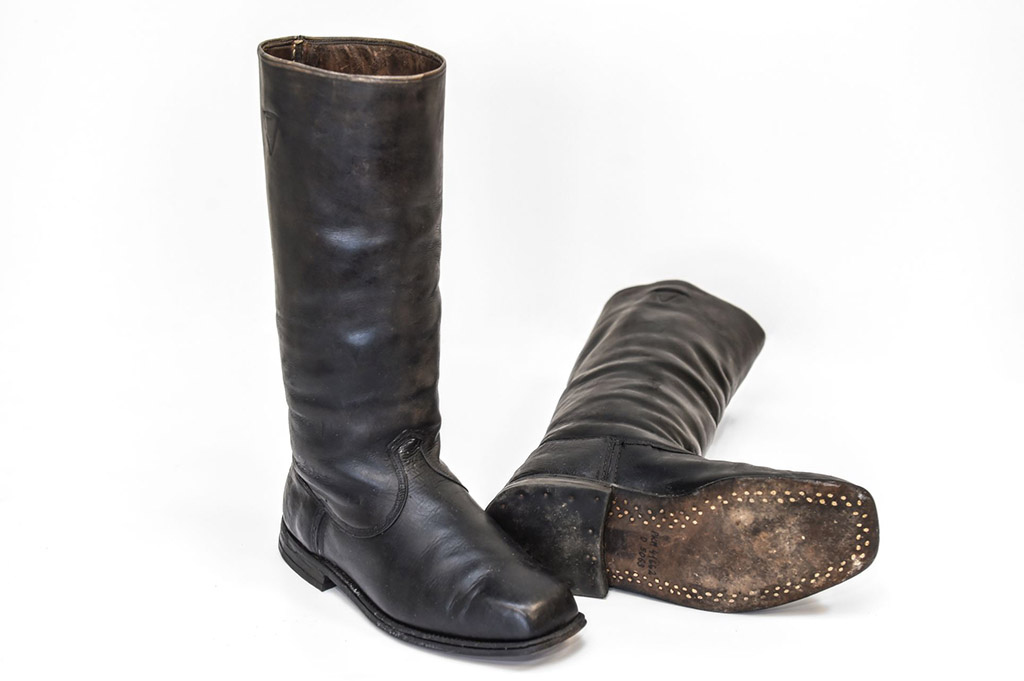
[:ru]Мужские кожаные сапоги с высоким голенищем. Середина ХХ века. Фотография Г. Картанаса .

Это были сапоги ручной работы, сделанные сапожником. Подошва укреплена деревянными гвоздями. В межвоенный период такую ​​обувь носили крестьяне, мастера, в послевоенное время — литовские партизаны. Эта пара обуви выставлена ​​в Паневежском краеведческом музее на выставке сопротивления и движения Саюдиса .
[:en]Men’s high-topped leather boots. Mid of 20th century. Photo of G. Kartanas.

It was handmade shoes made by shoemaker. The sole reinforced with wooden nails. In the interwar period, such shoes were worn by farmers, craftsmen, in the postwar period they were worn by Lithuanian partisans. This pair of shoes are exhibited in the Panevėžys Local Lore Museum Exhibition of the Resistance to the Soviet Occupation and the Sąjūdis Movement.[:]

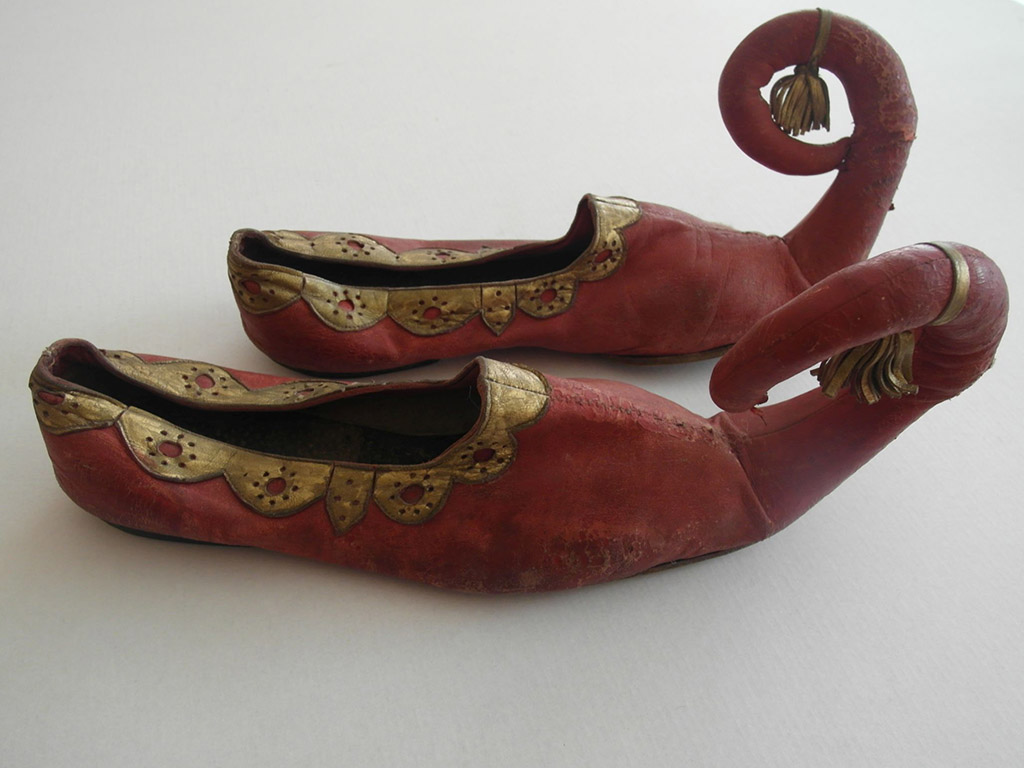
[:ru]Обувь колдуна Остроголового из спектакля Паневежского драматического театра «О тех, кто любит».

Спектакль поставил в 1955 году режиссер Йонас Алекна по пьесе Александра Антокольского. Роль колдуна Остроголового была исполнена актером Брониусом Бабкаускасом.  

[:en]Shoes of the character The Sharphead of Panevėžys Drama Theater performance “About those who love”.

The performance was staged in 1955 by director Jonas Alekna, based on a play by Aleksandras Antokolskis. The role of The Sharphead was performed by actor Bronius Babkauskas.[:]

[:ru]О проекте ENI-LLB-1-244 «Продвижение исторического и культурного наследия на пограничье посредством внедрения инноваций в музеях»

Проект направлен на создание платформы приграничного сотрудничества, создающей предпосылки для обеспечения растущего интереса туристов и посетителей к культурному и историческому наследию в приграничных районах Латвии, Литвы и Беларуси.

Этот проект финансируется Европейским Союзом.

Бюджет проекта: 367 864,64 евро, из них финансирование ЕС 331 078,17 евро, что составляет 865 111,50 белорусских рублей

Срок реализации проекта: 1 июня 2020 г. – 31 мая 2022 г.

Программа трансграничного сотрудничества Латвия-Литва-Беларусь 2014-2020 в рамках Европейского инструмента соседства

http://europa.eu/

 http://www.eni-cbc.eu/llb

https://eeas.europa.eu/delegations/belarus_en

[:en]

About the project ENI-LLB-1-244 “Promotion of historical and culture cross border through museums innovations” / Museum 2020

The project aims to build a cross border cooperation platform creating preconditions for ensuring the increasing interest of tourists and visitors about the cultural and historical heritage in the border area of Latvia, Lithuania and Belarus.

This project is funded by the European Union

Project budget: 367 864.64 EUR, EU funding 331 078.17 EUR

Project implementation period: 1st of June 2020 – 31st of May 2022

European Neighbourhood Instrument Cross-border Cooperation Programme Latvia-LithuaniaBelarus 2014-2020

http://europa.eu/;

http://www.eni-cbc.eu/llb

https://eeas.europa.eu/delegations/ belarus_be[:]

Прокрутить вверх